
Disclosure: This post contains affiliate links. We may earn a commission at no extra cost to you if you choose to sign up through our link.
Hiring internationally sounds exciting until you get close to the practical details.
At first, it feels simple: you find a talented developer in another country, a marketing specialist in a different time zone, or a remote operations manager who fits your budget and skill needs. Then the questions start coming. How do you pay them legally? Are they an employee or a contractor? Do you need to open a local company? What happens with taxes, contracts, benefits, local labour laws, and compliance?
That is where platforms like Deel become interesting.
Deel is designed for companies that want to hire, manage, and pay international workers without building a full legal, payroll, and HR structure in every country where they find talent.
But the real question is not simply, “What does Deel do?”
The better question is: Is Deel actually worth it in 2026 for businesses hiring and paying global teams?
After reviewing the platform from the perspective of a business owner, affiliate publisher, and someone who understands the challenges of working across borders, my answer is this: Deel can be very valuable if your business is serious about international hiring.
Let’s break it down below.
What Is Deel?
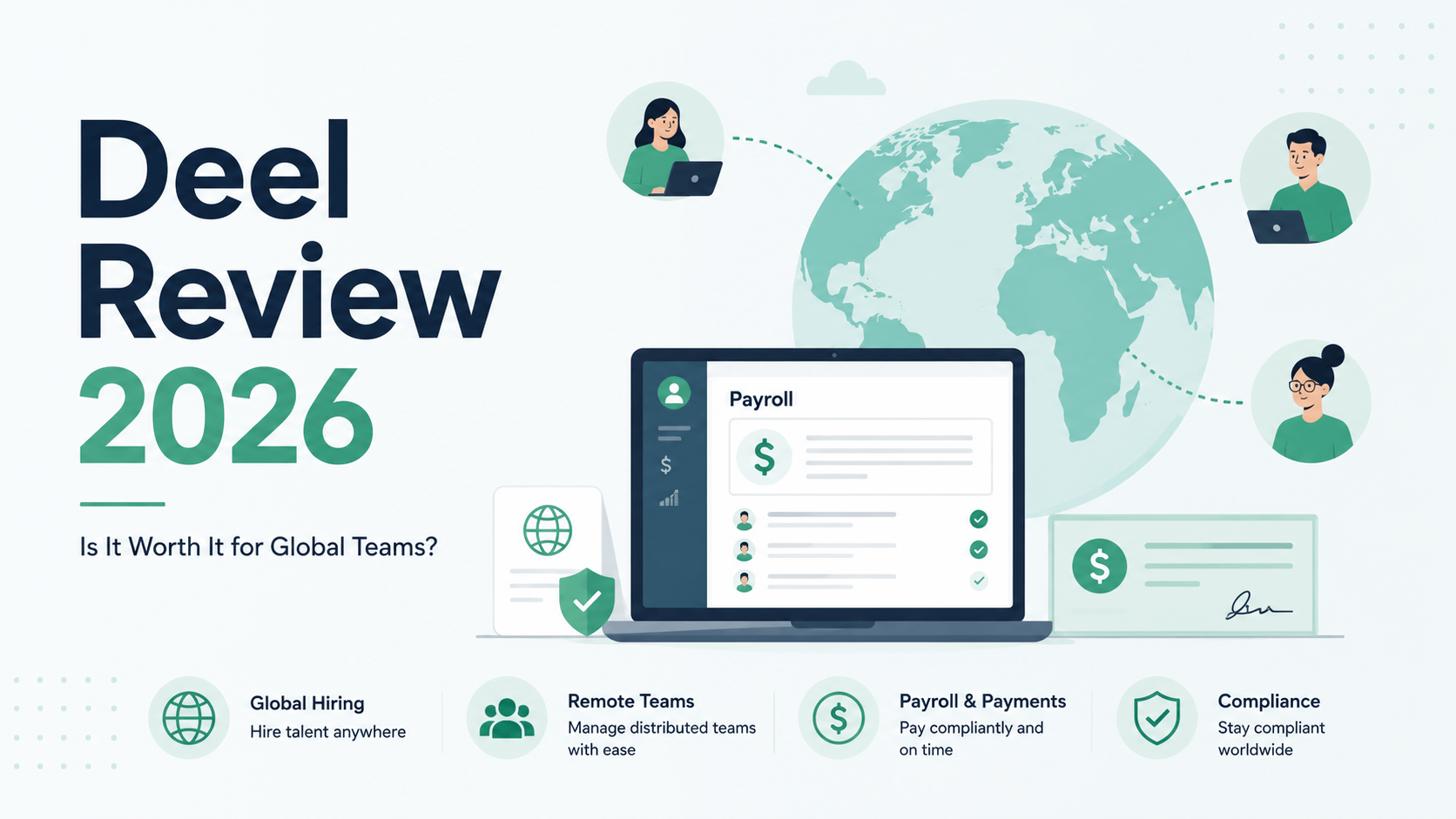
Deel is a global workforce platform that helps businesses hire, onboard, pay, and manage employees and contractors across different countries. It is best known for three major use cases:
- Employer of Record, or EOR
- Global Payroll
- Contractor Management
It also offers broader HR tools, compliance support, benefits, workforce management, and other services for distributed teams.
In simple terms, Deel aims to reduce friction in global hiring.
Instead of a business trying to understand employment rules in every country, create contracts manually, send payments through different systems, and coordinate payroll across regions, Deel brings much of that into one platform.
For small teams, that can save time. For fast-growing companies, it can reduce operational chaos. For larger companies, it can help standardize global hiring and payroll processes.
Who Is Deel Best For?
Deel is not only for huge multinational companies. That is one of the reasons it has become popular.
It can be useful for:
- Startups hiring their first international employees
- Remote-first companies with workers in different countries
- Agencies paying contractors in multiple regions
- SaaS companies expanding globally
- Businesses testing a new country before opening a local entity
- Companies that want to reduce manual payroll and compliance work
Where Deel becomes especially useful is when a company starts moving beyond casual freelancing.
For example, paying one writer through a basic freelance marketplace is one thing. But hiring ten remote team members across five countries is very different. At that point, you are not just sending money. You are managing contracts, worker classification, tax documents, payroll timelines, compliance expectations, and potentially benefits.
That is the type of situation where Deel makes more sense.
If your business is actively hiring globally, you can explore Deel through our referral link here.
Deel Employer of Record Review
The Employer of Record feature is one of Deel’s most important offerings.
An Employer of Record allows a company to hire an employee in another country without establishing a legal entity there. In practical terms, this means a business can bring someone onto the team in a new market without immediately creating a company branch, registering locally, or building a full HR and payroll operation in that country.
This matters because international employment is not as simple as signing a contract and sending a salary.
Every country has its own rules around:
- Employment contracts
- Termination procedures
- Tax contributions
- Social security
- Mandatory benefits
- Paid leave
- Payroll reporting
- Worker protections
If a business gets these wrong, the cost can be much higher than the salary itself.
With Deel’s EOR service, the idea is that Deel handles much of the local employment infrastructure. The company gets to work with the employee day to day, while Deel supports the legal employment, payroll, contracts, and compliance side.
From a business perspective, this can be a major advantage.
Imagine a startup that finds the perfect operations manager in Spain, a product designer in Kenya, or a customer success specialist in the Philippines. Without an EOR, the company may need to work with lawyers, accountants, payroll providers, and local advisors before hiring legally. That process can be slow and expensive.
With Deel, the company can move faster.
The main benefit here is not only convenience. It is speed combined with legal structure. For a company trying to build a global team, that combination can be powerful.
That said, EOR is not always the cheapest option. If you already have a large team in one country and plan to stay there long-term, opening your own local entity might eventually make sense. But for testing a market, hiring quickly, or managing a distributed team without building entities everywhere, Deel’s EOR service is one of its strongest features.
Deel Global Payroll Review
Global payroll is another area where Deel stands out.
Payroll becomes complicated when a company has workers in different countries. Each location may have different salary rules, currencies, tax deadlines, deductions, payslip requirements, and reporting obligations.
This is where many growing companies start to feel the pain of international hiring.
At the beginning, it may look manageable. You pay one person through a bank transfer, another through a payment app, and another through a local payroll provider. But as the team grows, the process becomes harder to control.
You may end up asking questions like:
- Who has already been paid this month?
- Which contractor invoice is still pending?
- Which country has a different payroll deadline?
- Are we using the right exchange rate?
- Do we have the correct tax and employment records?
- Are all payments properly documented?
Deel’s global payroll approach is useful because it gives companies one place to coordinate payroll across countries. For finance and HR teams, this can mean fewer disconnected systems and fewer manual mistakes.
The biggest advantage is visibility.
When payroll is spread across different providers, it can be difficult to know what has been paid, what is pending, which documents are missing, and whether everything is compliant. A centralized system makes it easier to manage.
For founders and small business owners, this may be even more important. Many small teams do not have a full HR department. The founder, operations manager, or finance lead may personally handle global payments. In that case, anything that reduces repeated admin work can be valuable.
However, companies should still review pricing carefully. Deel can simplify global payroll, but businesses need to compare the cost to their actual hiring volume, the countries involved, and their internal capacity.
Deel Contractor Management Review
Contractor management is probably the most relevant Deel feature for many small businesses, agencies, and online companies.
Many businesses do not begin global hiring by hiring full-time international staff. They start with contractors. Designers, writers, virtual assistants, developers, consultants, editors, media buyers, and customer support agents are often hired as independent contractors first.
That sounds simple, but it still comes with risks.
The main issue is worker classification. In some countries, treating someone as a contractor when they function like an employee can create legal and tax problems. Businesses also need contracts, invoices, payment records, tax forms, and localized documentation.
This is one area where Deel feels especially practical.
If you run an online business and work with contractors from different countries, you probably know the pain of inconsistent processes. One contractor sends invoices by email. Another prefers bank transfer. Another wants a different payment method. Someone forgets to send an invoice. Someone asks for a different contract format. You end up managing people, payments, and paperwork manually.
Deel helps organize that.
For a growing team, contractor management can be a good entry point into Deel before moving into EOR or full global payroll. It gives businesses a more structured way to work with international talent without immediately committing to employment contracts.
What Could Be Better?
No platform is perfect, and Deel is not automatically the right choice for every business.
Here are a few things to consider before signing up.
1. It May Be More Than Very Small Teams Need
If you only work with one or two freelancers occasionally, Deel may feel like too much. You might not need a full global hiring platform yet.
However, if you expect to hire more international workers, it may be worth adopting a structured system early..
2. Some Companies May Still Need Local Advice
Deel can help with compliance, contracts, and payroll infrastructure, but companies with complex legal, tax, or employment situations may still need additional professional advice.
For example, if you are restructuring a large workforce, dealing with unusual tax exposure, or planning long-term expansion into a country, Deel may be part of the solution but not the only advisor you need.
5. It Works Best When Your Internal Processes Are Clear
A platform cannot fix unclear hiring decisions.
Before using Deel, businesses should still know whether they are hiring someone as a contractor or employee, what the person’s role is, how they will be managed, how compensation will work, and who internally approves contracts and payments.
Deel can make the process smoother, but your company still needs good internal discipline.
Deel Pricing: Is It Expensive?
This is one of the biggest questions buyers have.
The honest answer is: Deel may look expensive if you compare it only to sending money manually, but it can look reasonable if you compare it to the cost of setting up entities, hiring local advisors, managing compliance mistakes, or running disconnected payroll systems.
That is the right way to think about it.
If you are paying a single freelancer, a global hiring platform may feel like an unnecessary cost. But if you are hiring employees in countries where you have no entity, or managing payroll across several markets, the cost of doing it manually can become much higher than expected.
The value of Deel is not just the software interface. It is the infrastructure behind it.
For EOR, the value is being able to hire without opening a local entity. For global payroll, the value is coordination and compliance across countries. For contractor management, the value is structured onboarding, contracts, invoices, classification support, and payments.
So, is Deel cheap? Not necessarily.
Is it worth paying for if global hiring is important to your business? Very possibly.
Learn more about Deel’s pricing here, depending on which service you need here.
Is Deel Good for Small Businesses?
Yes, but with context.
Deel can be good for small businesses that are serious about hiring internationally. It can help them look more professional, reduce administrative stress, and avoid some of the confusion that comes with cross-border work.
But if a small business has no immediate plan to hire globally, Deel may not be necessary yet.
The sweet spot is a small business that is growing beyond local hiring. For example, a digital agency hiring remote contractors, a startup hiring its first international employee, or an online company building a distributed team.
For those businesses, Deel can be a practical tool rather than just an enterprise platform.
Is Deel Good for Startups?
Deel is especially well-suited for startups, as they often need to move quickly.
A startup may find the right candidate in another country but not have the time or budget to open a local entity. It may also want to test a market before making a permanent expansion decision.
Deel’s EOR and contractor tools make that easier.
For startups, the biggest advantage is speed. You can hire globally without turning every country into a legal research project. That does not mean you should ignore legal and financial details, but Deel gives you a more structured path.
Is Deel Good for Agencies?
Agencies can also benefit from Deel, especially if they work with international contractors.
Many agencies rely on remote talent for design, content, development, SEO, paid ads, video editing, and operations. Managing that manually can become messy.
Deel contractor management gives agencies a more organized way to onboard contractors, manage contracts, and process payments.
For agencies working with contractors in many countries, this can be a practical upgrade from spreadsheets and scattered payment tools.
Deel vs. Doing It Yourself
Some businesses may wonder why they should use Deel at all. Why not just hire people directly and pay them through bank transfers?
That can work in very simple situations.
But doing it yourself becomes risky when:
- You are unsure whether someone should be classified as an employee or a contractor
- You are hiring in a country where you do not understand employment law
- You need compliant contracts
- You are managing multiple currencies
- You are paying many people in different countries
- You need payroll records and documentation
- You want a repeatable process as your team grows
Manual systems can feel cheaper until something goes wrong or becomes too time-consuming.
Deel is not just a payment tool. It is a global workforce management platform. That difference matters.
Final Verdict: Is Deel Worth It in 2026?
Yes, Deel is worth considering in 2026 if your business is hiring or planning to hire globally.
Its strongest value is for companies that want to:
- Hire employees in countries where they do not have entities
- Manage international contractors more professionally
- Run payroll across multiple countries
- Reduce global compliance complexity
- Build a remote or distributed team with less administrative friction
The platform is especially useful for startups, remote-first companies, agencies, SaaS businesses, and growing teams that want access to global talent without building a legal and payroll operation from scratch.
However, Deel may not be necessary for everyone. If you only hire occasional freelancers and have no plans to scale internationally, you may not need the full platform yet. But if global hiring is part of your business strategy, Deel can save time, reduce confusion, and make international team management feel much more realistic.
If you are ready to explore Deel for global hiring, payroll, EOR, or contractor management, try Deel here.
About the Author