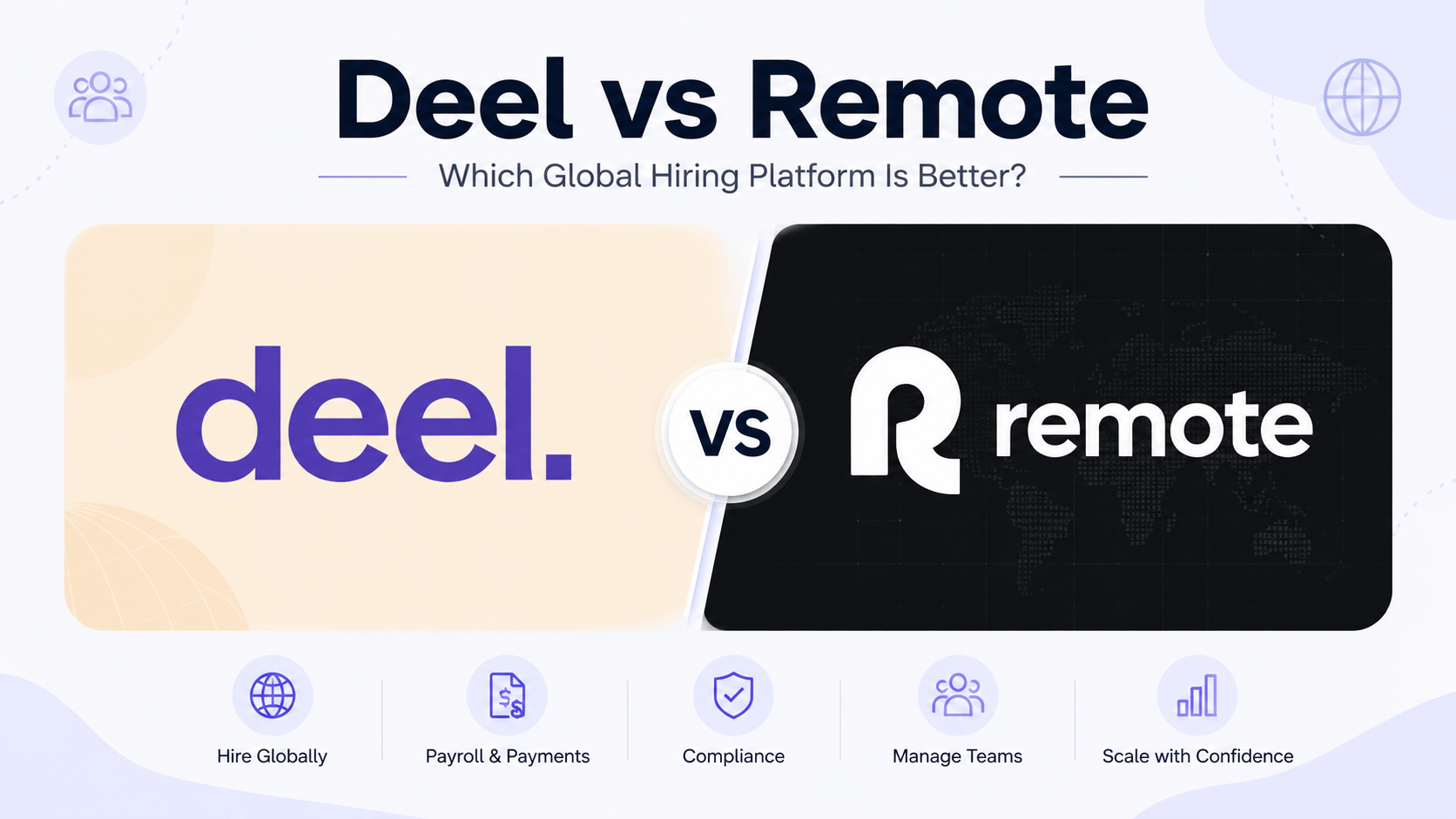
Deel vs Remote 2026
Affiliate disclosure: This article contains affiliate links. If you sign up through our link, we may earn a commission at no extra cost to you. Our opinions remain our own, and we aim to provide a fair, practical comparison to help you make a better business decision. Learn more in our full disclosure.
To note: By Remote, we mean Remote.com throughout the article.
Hiring internationally is no longer something only large corporations do.
Today, a startup in London can hire a developer in Brazil, a designer in South Africa, a sales manager in Germany, and a customer support specialist in the Philippines without everyone being in the same office or even the same time zone. That flexibility is one of the biggest advantages of modern work.
But the moment you move from “I found a great person abroad” to “How do I actually hire and pay this person legally?”, things get more complicated.
You have to think about contracts, payroll, taxes, benefits, compliance, worker classification, employment laws, currencies, invoices, and country-specific rules. That is where global hiring platforms like Deel and Remote come in.
Both Deel and Remote help companies hire, manage, and pay international employees and contractors. Both are strong platforms. Both are widely used by remote-first teams and growing companies. And both can help businesses avoid the headache of opening local entities in every country where they want to hire.
But they are not exactly the same.
So in this detailed Deel vs Remote 2026 comparison, we will look at how both platforms compare across pricing, Employer of Record services, contractor management, global payroll, compliance support, usability, and best-fit use cases.
If you are already considering Deel for global hiring, you can explore it here.
Quick Verdict: Deel vs Remote
If you want the simplest possible answer, here it is:
“Deel is likely the better fit for companies that want a broader global workforce platform covering Employer of Record, global payroll, contractor management, HR tools, compliance, benefits, and workforce operations in one place.”
“Remote is also a strong choice, especially for companies that want a focused global employment platform with transparent pricing, strong EOR capabilities, contractor management, and emphasis on owned local entities.”
In other words, this is not a case where one platform is good and the other is bad. Both can be useful. The better choice depends on what your business needs most.
If you want breadth, flexibility, and a wider workforce management ecosystem, Deel may be more attractive.
If you want a focused EOR and contractor platform with clear pricing and a strong global employment message, Remote is also worth considering.
For many startups, agencies, SaaS companies, and remote-first businesses, however, Deel’s broader product ecosystem may make it the more practical long-term option.
Deel vs Remote: Comparison Table
| Category | Deel | Remote | Better Fit |
|---|---|---|---|
| Employer of Record | Starts at $599 per employee/month; full legal employment in 110+ countries | $599/month annually or $699/month monthly; hire without entity in 90+ countries | Deel for broader country coverage; Remote for transparent EOR positioning |
| Contractor Management | Starts at $49 per contractor/month | Starts at $29 per contractor/month | Remote on entry price; Deel for broader payment and workforce ecosystem |
| Contractor of Record | Starts at $325 per contractor/month | From $325 per contractor/month | Tie on the public starting price |
| Global Payroll | Starts at $29 per employee/month | Starts at $29 per employee/month | Tie on public starting price |
| Compliance Support | Strong compliance, contracts, payroll, tax filings, HR/legal expertise | Strong compliance, local payroll, benefits, taxes, legal employment | Tie |
| Platform Breadth | EOR, payroll, contractors, HR, benefits, immigration, IT, PEO and more | EOR, contractors, payroll, HR, relocation, equity and related tools | Deel for broader workforce stack |
| Best For | Companies wanting one platform for global workforce operations | Companies focused on global employment and contractor operations | Depends on business needs |
Pricing and feature details are based on public pricing and product pages available at the time of writing (May 21st 2026). Deel lists EOR from $599 per employee/month, Contractor Management from $49 per contractor/month, Contractor of Record from $325 per contractor/month, and Global Payroll from $29 per employee/month. Remote lists EOR at $599/month when paid annually or $699/month monthly, Payroll from $29 per employee/month, Contractor Management from $29 per contractor/month, Contractor Management Plus from $99 per contractor/month, and Contractor of Record from $325 per contractor/month.
What Is Deel?
Deel is a global payroll, HR, and compliance platform built for companies that hire and manage workers internationally. Its core products include Employer of Record, global payroll, contractor management, Contractor of Record, HR tools, benefits, immigration support, PEO, and IT-related workforce tools.
In simple terms, Deel helps companies hire and pay people across countries without building a separate HR and legal structure in every market.
For example, if your company is based in the United States or the United Kingdom and wants to hire a full-time employee in another country, Deel’s Employer of Record service can help you employ that person without opening a local entity. Deel’s EOR plan is designed to support legal employment, automated onboarding and compliance, benefits enrollment, managed payroll, tax filings, reporting, HR/legal expertise, and support.
Deel also supports companies that already have entities abroad and need global payroll infrastructure. Its Global Payroll plan starts at $29 per employee/month and supports local tax, statutory filing and reporting, multi-currency payroll and payments, country-specific pay rules, employee self-service, reporting, and integrations.
The strongest thing about Deel is that it feels like a broad global workforce platform rather than only an EOR tool. That makes it attractive for companies that may start with contractors, later hire employees through EOR, then add payroll, HR, benefits, or other workforce tools over time. We made a detailed review of Deel, which can be found here.
What Is Remote?
Remote is also a global employment and payroll platform. Like Deel, it helps businesses hire employees internationally without opening local entities, manage international contractors, and run payroll across countries.
Remote’s Employer of Record service allows companies to hire employees in countries where they do not have a legal entity. Remote acts as the legal employer and helps manage payroll, employment contracts, taxes, benefits, and compliance responsibilities.
Remote strongly emphasizes compliant global employment. It also highlights its use of owned local entities in countries where it operates, which can matter to companies that want direct control and consistency in the employee experience.
Remote’s product set includes Employer of Record, payroll, contractor management, Contractor of Record, HR management, relocation, equity, and other related global workforce tools.
Remote is especially appealing to companies that want transparent pricing and a clean, focused global employment platform.
1. Employer of Record: Deel vs Remote
Employer of Record is one of the most important areas to compare.
An Employer of Record, or EOR, allows a company to hire an employee in another country without opening its own legal entity there. The EOR becomes the legal employer, while the client company manages the employee’s day-to-day work.
This is useful because hiring internationally is not only about paying a salary. Companies also have to consider local employment contracts, taxes, mandatory benefits, leave policies, payroll rules, termination rules, worker protections, and compliance requirements.
Deel EOR
Deel’s EOR plan starts at $599 per employee/month. Public pricing states that Deel EOR includes full legal employment in 110+ countries, support for remote, on-site and field workers, automated onboarding and compliance, benefits enrollment, managed payroll, tax filings, reporting, on-demand HR/legal expertise, and support.
That makes Deel a strong option for companies that want an EOR solution inside a broader workforce platform.
A startup, for example, may first use Deel to hire one employee abroad, then later use the same platform for contractors, payroll, HR records, or benefits. That flexibility is one of Deel’s advantages.
Remote EOR
Remote’s EOR pricing is listed at $599/month when paid annually or $699/month when paid monthly. Remote says its EOR service helps companies hire without opening a legal entity in 90+ countries, with onboarding support, local payroll, compliance protections, localized benefits, and dedicated in-house experts.
Remote is very competitive here. Its EOR product is clear, focused, and built around compliant global employment.
EOR Verdict
Both platforms are strong for EOR.
Deel may be better if you want a broader platform with EOR connected to global payroll, contractors, HR, benefits, IT, and other workforce operations.
Remote may be better if your main priority is a focused EOR provider with transparent pricing and strong emphasis on owned entities.
For many growing companies, Deel has a slight edge because it gives more room to expand into other workforce tools as hiring becomes more complex.
2. Contractor Management: Deel vs Remote
Contractor management is especially important for small businesses, agencies, online companies, and startups.
Many businesses do not begin global hiring with full-time employees. They start with contractors: developers, writers, designers, consultants, virtual assistants, marketers, and customer support agents.
At first, this can feel simple. But once you work with contractors in several countries, the process becomes harder to manage. You need contracts, invoices, payment tracking, tax forms, documentation, and possibly worker classification support.
Deel Contractor Management
Deel’s Contractor Management plan starts at $49 per contractor/month. It includes centralized contractor management, compliant contracts, payments in 120+ currencies, automated invoicing, tax form guidance and document collection, and multi-currency payments.
Deel also offers Contractor of Record from $325 per contractor/month, where Deel acts as the legal contracting entity, supports compliance and classification, helps reduce misclassification risks, and handles automated payment and invoicing.
This is useful for companies that want more protection and structure around contractor relationships.
Remote Contractor Management
Remote’s Contractor Management starts at $29 per contractor/month. It includes the ability to work with international contractors, create and sign localized contracts, approve contractor invoices, use auto-pay, and maintain payment visibility. Remote also offers Contractor Management Plus at $99 per contractor/month, which includes stronger compliance and indemnity protections, and Contractor of Record from $325 per contractor/month.
On entry-level pricing, Remote is cheaper than Deel for contractor management.
Contractor Management Verdict
Remote wins on entry-level contractor management pricing.
However, Deel may still be attractive if you want contractor management inside a broader global workforce system with payments, EOR, payroll, HR, and compliance tools connected together.
For a small agency that mainly pays contractors and wants lower monthly contractor costs, Remote may be appealing. For a company that expects to grow from contractors into employees, EOR, and global payroll, Deel may be more future-proof.
3. Global Payroll: Deel vs Remote
Global payroll matters when your company already has legal entities in other countries but needs a better way to coordinate payroll.
This is different from EOR. With EOR, the provider legally employs the worker. With global payroll, your business may already be the legal employer, but it needs help running payroll across countries.
Deel Global Payroll
Deel’s Global Payroll starts at $29 per employee/month. It includes local tax, statutory filing and reporting, multi-currency payroll and payments, country-specific pay rules and calculations, employee self-service, integrated reporting, payroll analytics, and HR/accounting integrations.
This is a strong offering for companies managing payroll in several countries and trying to reduce manual processes.
For example, a business with employees in the US, UK, Canada, and several international markets may want one place to coordinate payroll data, filings, reporting, and payments.
Remote Payroll
Remote’s Payroll also starts at $29 per employee/month. Remote’s payroll product is designed for organizations that already have legal entities in foreign countries but need centralized payroll infrastructure. Its public pricing includes international payroll support, a self-service platform, specialist support, local payroll regulation support, benefits management, and HR Core.
Remote is also competitive here.
Global Payroll Verdict
Public starting prices are equal at $29 per employee/month for both Deel and Remote.
The better choice depends on your overall stack. If your company already uses Deel for EOR or contractors, Deel Global Payroll may be easier to add. If your company uses Remote for EOR, Remote Payroll may be the more natural extension.
If starting from scratch, Deel’s broader platform may make it more attractive for companies that want payroll to sit inside a wider HR and workforce management system.
4. Compliance Support: Deel vs Remote
Compliance is one of the main reasons companies use platforms like Deel and Remote in the first place.
International hiring is full of country-specific rules. A worker who is properly classified as a contractor in one country may be treated differently in another. Payroll deadlines, benefits, tax obligations, leave rules, and termination protections can vary significantly.
Deel Compliance
Deel includes automated onboarding and compliance in its EOR plan, as well as managed payroll, tax filings, reporting, and HR/legal expertise. Its Contractor of Record plan also supports compliance and classification, tax and labor law adherence, and helps reduce misclassification risks.
This makes Deel useful for companies that want to reduce the operational burden of figuring out every country’s rules manually.
Remote Compliance
Remote also has strong compliance positioning. Its EOR service helps manage payroll, employment contracts, taxes, benefits, and compliance responsibilities. Remote also emphasizes the risks of contractor misclassification and positions its EOR and Contractor of Record services as ways to reduce compliance exposure.
Remote also strongly emphasizes owned local entities and intellectual property protections, which may appeal to companies that care deeply about employment structure and legal control.
Compliance Verdict
This is close.
Both platforms are strong on compliance. Deel may be better if you want compliance support across a broader workforce platform. Remote may be better if you specifically value its messaging around owned entities, EOR structure, and IP protection.
For most small and mid-sized businesses, either platform is likely much safer than trying to manage international hiring through spreadsheets, generic contracts, and manual payments.
5. Pricing: Deel vs Remote
Pricing is one of the easiest areas to compare, but it still needs context.
Here is a simplified view of publicly listed starting prices:
| Product | Deel | Remote |
|---|---|---|
| Employer of Record | From $599/employee/month | $599/month annually or $699/month monthly |
| Global Payroll | From $29/employee/month | From $29/employee/month |
| Contractor Management | From $49/contractor/month | From $29/contractor/month |
| Contractor of Record | From $325/contractor/month | From $325/contractor/month |
Based on pricing, Remote is cheaper for basic contractor management. Deel and Remote are similar for EOR when Remote is paid annually, while Remote is higher if paid monthly. Both list global payroll from $29 per employee/month. Deel and Remote both list Contractor of Record from $325 per contractor/month.
But pricing should not be judged only by the lowest monthly number.
Businesses should also consider:
- Which countries they need
- Whether they need EOR or only contractors
- Whether they already have local entities
- Whether they need payroll, HR, benefits, or compliance add-ons
- Whether they want one platform or several tools
- Support quality
- Contract terms
- Employee experience
- Long-term hiring plans
If you only need low-cost contractor management, Remote may look more attractive. If you need a broader workforce platform that can grow with your company, Deel may be worth the extra cost in some situations.
6. Platform Breadth and Ecosystem
This is where Deel becomes especially interesting.
Deel is not only EOR and contractor management. It also includes global payroll, HR tools, benefits, PEO, immigration and visa support, IT tools, device management, and other workforce-related services.
Remote also has a growing product ecosystem, including EOR, payroll, contractor management, Contractor of Record, HR management, relocation, expansion support, and equity-related services.
But Deel still feels broader as an all-in-one workforce operating system, especially for companies that want payroll, HR, compliance, contractors, benefits, immigration, and IT workflows under one roof.
This does not mean every company needs all of that. A small startup may not need IT device management or visa support right now. But as teams grow, having more options inside the same ecosystem can be useful.
Platform Breadth Verdict
Deel wins on breadth.
Remote is strong and focused, but Deel feels like the more complete global workforce platform for companies that expect their hiring and HR operations to become more complex over time.
7. Ease of Use and User Experience
Ease of use is harder to judge from public pricing pages alone because it depends on your team, workflow, and internal processes.
In general, both Deel and Remote are designed to simplify global hiring. They offer dashboards, workflows, employee and contractor records, payment tools, and onboarding processes.
For a founder or operations manager, the main question is not “Which interface is prettier?” The real question is:
Which platform makes my hiring, payroll, and compliance process easier to manage every month?
Deel may feel more comprehensive, but that can also mean there is more to learn if you only need one simple feature. Remote may feel more focused for teams that mainly need EOR and contractor management.
Usability Verdict
This is a tie, with a slight difference in philosophy.
Choose Deel if you want one broader platform and do not mind a richer product ecosystem.
Choose Remote if you prefer a focused global employment platform and want a simpler contractor/EOR-first workflow.
8. Customer Support and Expert Help
Support matters a lot in global hiring.
When payroll is involved, mistakes are stressful. When compliance is involved, delays can be expensive. When employee onboarding is involved, a poor experience can affect the worker’s trust in your company.
Deel’s EOR plan includes support and access to HR/legal expertise. Remote also highlights onboarding support, specialist help, and local expertise for global employment and payroll.
Both platforms understand that support is part of the product.
For businesses comparing them, the best move is to ask detailed support questions during demo calls. For example:
- Will we get a dedicated account manager?
- What support is available during payroll deadlines?
- How quickly do you respond to country-specific compliance questions?
- Do employees and contractors get direct support?
- What happens if an onboarding or payment issue occurs?
- Are support channels available in our time zone?
Support Verdict
Both platforms appear strong on support, but the best choice may depend on your plan, company size, and countries involved.
For serious buyers, this is something to test during the sales process rather than assume from marketing copy.
9. Best for Startups
Startups usually need speed.
They may not have a big HR department. The founder, operations lead, or finance manager may be doing hiring, onboarding, payroll, and compliance at the same time.
For startups, both Deel and Remote can be helpful.
Remote may appeal to startups that want transparent pricing and a straightforward way to hire internationally.
Deel may appeal more to startups that expect to grow into a more complex global team and want a platform that can support contractors, EOR employees, payroll, HR, benefits, and other workforce tools over time.
Startup Verdict
Deel is the better fit for startups that want room to grow into a broader workforce platform.
Remote is a strong option for startups that want a focused EOR or contractor solution with competitive contractor pricing.
10. Best for Agencies
Agencies often work with international contractors before they hire full-time employees. They may need to pay designers, developers, writers, media buyers, editors, virtual assistants, and consultants across different countries.
For agencies, contractor management pricing matters.
Remote starts at $29 per contractor/month, while Deel starts at $49 per contractor/month for contractor management. So, for a cost-conscious agency managing many contractors, Remote may be attractive.
However, Deel can still make sense for agencies that want a broader system and may eventually hire employees, manage payroll, or add HR tools.
Agency Verdict
Remote may be better for agencies focused mainly on contractor management cost.
Deel may be better for agencies building a more permanent global team or wanting a broader platform beyond contractor payments.
11. Best for Global Payroll Teams
If your company already has legal entities in other countries, global payroll becomes a major issue.
Both Deel and Remote list global payroll from $29 per employee/month. Deel’s Global Payroll includes local tax, statutory filing and reporting, multi-currency payroll and payments, country-specific pay rules, employee self-service, reporting, payroll analytics, and integrations. Remote’s Payroll includes international payroll support, a self-service platform, specialist support, local payroll regulation support, benefits management, and HR Core.
Payroll Verdict
This is close.
Deel may have a slight edge for companies that want global payroll connected to a broader HR and workforce platform.
Remote is still a strong option for companies that want centralized payroll infrastructure and a focused global employment provider.
Pros and Cons of Deel
Deel Pros
- Strong all-in-one global workforce platform
- EOR from $599 per employee/month
- Global Payroll from $29 per employee/month
- Contractor Management and Contractor of Record options
- Broad product ecosystem covering HR, payroll, contractors, benefits, visas, PEO, and IT
- Good fit for startups, SaaS companies, remote teams, and growing international businesses
- Useful if you want one platform that can grow with your company
Deel Cons
- Contractor Management starts higher than Remote’s entry-level contractor plan
- The broad ecosystem may feel like more than very small teams need
- Some pricing may still require speaking to sales, depending on product and plan
- Businesses with very simple contractor needs may not need the full platform
Pros and Cons of Remote
Remote Pros
- Strong EOR platform with clear pricing
- EOR available at $599/month annually or $699/month monthly
- Contractor Management starts at $29 per contractor/month
- Global Payroll starts at $29 per employee/month
- Strong compliance and owned-entity positioning
- Good fit for companies focused on EOR and contractor operations
- Transparent pricing structure
Remote Cons
- EOR country coverage is listed at 90+ countries, compared with Deel’s 110+ on public pricing pages
- Platform may feel narrower than Deel for companies wanting a full workforce operations stack
- Monthly EOR pricing is higher than the annual rate
- Some advanced contractor protections require higher-tier plans
Final Verdict: Deel vs Remote 2026
So, which platform is better: Deel or Remote?
The honest answer is that both are strong. But they are better for slightly different types of companies.
Choose Remote if your main priority is lower entry-level contractor management pricing, a focused EOR platform, transparent pricing, and strong emphasis on owned local entities.
Choose Deel if you want a broader global hiring and workforce management platform that can support contractors, EOR employees, global payroll, HR, compliance, benefits, visas, PEO, IT workflows, and more as your company grows.
For many businesses, Deel may be the better long-term choice because it gives you more room to expand. You might start with contractor management, then hire employees through EOR, then add global payroll, HR, benefits, or other tools later. That makes Deel feel less like a single-purpose hiring tool and more like a global workforce operating system.
Remote is excellent for companies that want a focused, transparent, and reliable global employment platform.
But if the question is “Which platform gives my business more flexibility as global hiring becomes more complex?”, Deel has a strong case.
If you are ready to explore Deel for global hiring, payroll, EOR, or contractor management, you can start here.
About the Author